

Introduction
Sunglasses are protective eyewear designed to shield the eyes from damage caused by intense sunlight. Beyond their protective role, they also serve as a fashion accessory that reflects personal style. Therefore, choosing the right sunglasses involves considering both eye protection and personal preferences, making an understanding of sunglasses testing methods and standards essential.
The dual function of sunglasses—protection and style—makes them highly desirable. However, since they directly affect eye safety, their quality standards are stringent.
From a quality control perspective, inspection partners must know how to evaluate sunglasses. In this article, White Angel sunglasses manufacturers provide a concise overview of sunglasses testing methods and standards.

1.Rules for Inspecting Sunglasses Quality
A good pair of sunglasses plays a vital role in outdoor environments with strong sunlight. Qualified sunglasses should come with an inspection report.
Quality evaluation considers two main aspects: technical quality and aesthetic appeal. While aesthetics are subjective, quality is measured against defined standards. The primary focus in quality assessment is on the lenses.
The globally recognized standard is that of the U.S. Food and Drug Administration (FDA):
- FDA standards require lenses to block over 90% of ultraviolet (UV) rays while maintaining visible light transmission. Lenses should carry the label “UV-100PROTCT10N.” When 100% of UV rays are blocked, the label reads “UV-400PROTCT10N.” Checking the UV label is therefore crucial.
- Lenses should not have corrective diopters like optical glasses. A deviation beyond 15% may cause dizziness when worn.
- Lenses must have sufficient strength and pass impact resistance testing. Typically, plastic, resin, and glass sheets increase in strength in that order.
1.2 Choosing Sunglasses That Suit You
- Cyclists benefit most from resin lenses.
- For sports, sunglasses with larger frame curvature or adjustable straps are recommended.
- Nearsighted or farsighted individuals can use clip-on sunglasses or prescription-specific models.
In spring and autumn, lighter lenses and solid-colored frames work well. In winter, brighter frame colors and tinted lenses for snowy conditions are preferable, along with slightly larger frames to shield from wind.
Sunglasses prices vary depending on brand, materials, packaging, style, color, and marketing. Very cheap options often lack quality assurance. Purchasing from reputable optical stores or department store counters generally ensures product inspection and health standards are met.
2.Sunglasses Testing Methods
Sunglasses fall under personal eye and face protection equipment. Their quality is assessed based on vertex power, UV protection, mechanical impact resistance, and glare reduction. Key points during testing include:
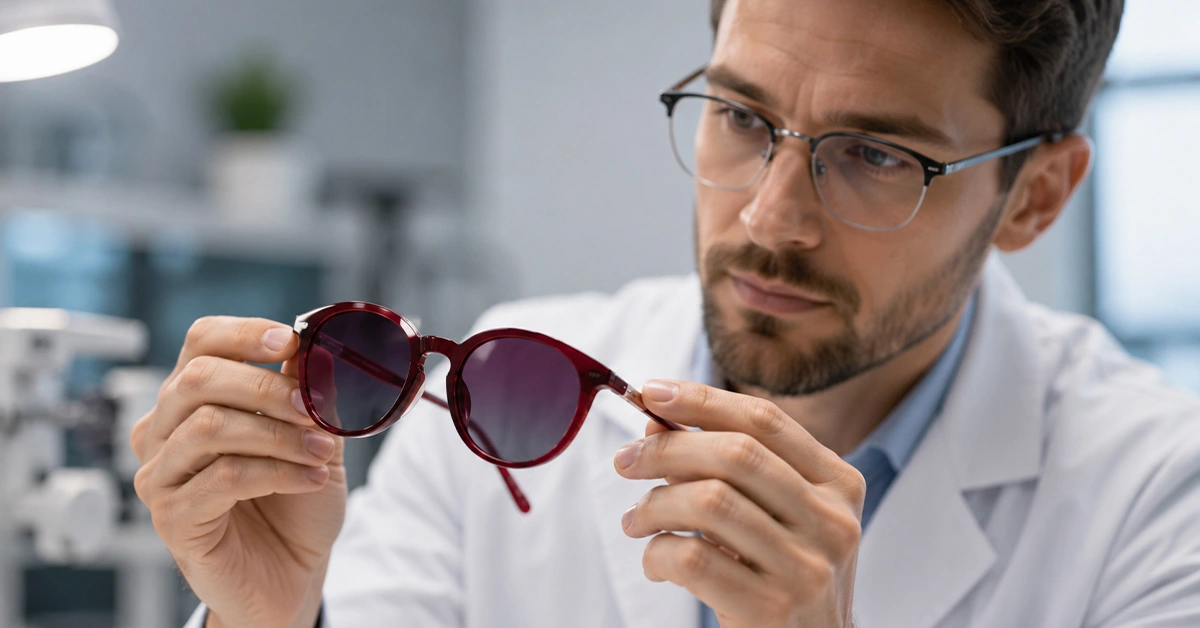
2.1 Lens UV Transmittance Testing Principle
Lens transmittance is not a simple average of spectral transmittance at each wavelength. Instead, it is calculated through weighted integration, reflecting the human eye’s sensitivity to different wavelengths.
The eye is highly sensitive to green light, making its transmittance critical. Conversely, red and purple light have less influence on perceived light transmittance.
A reliable method for testing UV protection is quantitative measurement of UVA and UVB spectral transmittance.
2.2 Instruments and Methods
A spectral transmittance meter measures lens performance in the UV region. The device is connected to a computer, calibrated at 23℃±5℃ (without lenses or filters in the measurement area), and set to 280–480 nm. The UV transmittance curve is then observed. Lenses and holders must be cleaned before testing.
2.3 Testing Challenges
Different standards (e.g., QB2457 vs. ISO8980-3) can yield significantly different UV transmittance results for the same sample, sometimes differing by over 13%. Reference standards directly affect measurement accuracy and reliability.
Research indicates resin lenses offer the best transmittance, followed by glass, while crystal lenses perform the worst. Among resins, CR-39 lenses surpass PMMA in performance.
3.Sunglasses Export Testing Requirements
3.1 Overview
Sunglasses, as protective eyewear, must meet technical criteria including spectral performance, optical power, prism, surface finish, flame resistance, and mechanical strength. Metal frame coatings containing nickel may pose health risks.
Global standards include Europe’s EN 1836, U.S. ANSI Z80.3, Australia’s AS/NZS 1067, and China’s QB2457. In the U.S., sunglasses are regulated as medical devices under the FDA. In the EU, they are considered personal protective equipment, requiring CE certification for market entry.
3.2 Spectral Performance
- Visible spectrum (380–780 nm): Transmittance measures the ratio of transmitted to incident radiant energy. It varies with thickness, structure, wavelength, scattering, and temperature. Sunglasses are classified by visible light transmittance.
- UV spectrum: UV transmittance is regulated to prevent eye damage, covering UVA and UVB bands.
3.3 Optical and Prism Power
Focal power measures lens ability to bend light; prism refers to light deviation. European EN1836:2005 defines two levels, each with specific horizontal and vertical tolerances.
3.4 Material and Surface Quality
Inspection is performed under light and dark backgrounds without magnification. Central lens areas are checked for bubbles, scratches, impurities, mildew, stains, or cracks.
3.5 Flame Resistance
European, Australian, and Chinese standards test flame resistance by applying a heated steel rod for a few seconds. ANSI Z80.3 uses a 200℃ environment for 15 minutes. Both methods assess flammability under high heat.
3.6 Mechanical Strength
Three tests assess lens durability: impact resistance, compression, and nose bridge deformation.
- Impact test: A steel ball is dropped on the lens to evaluate toughness.
- Compression test: Lenses withstand a steel ball load without breaking or deforming.
- Nose bridge deformation: Deformation should not exceed ±2%, and lenses must remain in the frame.
Conclusion
Sunglasses have a significant global export market, but manufacturers must comply with strict quality and safety standards to ensure effective UV protection, optical performance, and user safety. Understanding sunglasses testing methods and standards is essential for meeting international certification and market access requirements.
For manufacturers, eyewear designers, and entrepreneurs planning to create a sunglasses brand, mastering quality testing and regulatory requirements is a key step toward developing reliable products and competing successfully in the global eyewear market. Since frame materials also influence durability, comfort, and overall product quality, selecting the right frame construction is an important part of eyewear development. Learn more about metal eyeglass frames and their role in creating durable and stylish eyewear.